
A Rotary eClub and a traditional Rotary club are both full Rotary clubs. They run service projects, elect a Board and officers, support The Rotary Foundation, and answer to the same Rotary International standards. The difference between them is how, and how often, members come together: a traditional club meets in person each week, while an eClub meets mostly online, often with an in-person gathering once a month. Neither is the senior or the lesser form; they suit different lives. This article sets out the practical differences so you can see which fits yours.
For what an eClub is to begin with, see what a Rotary eClub is.
How often does each type of club meet?
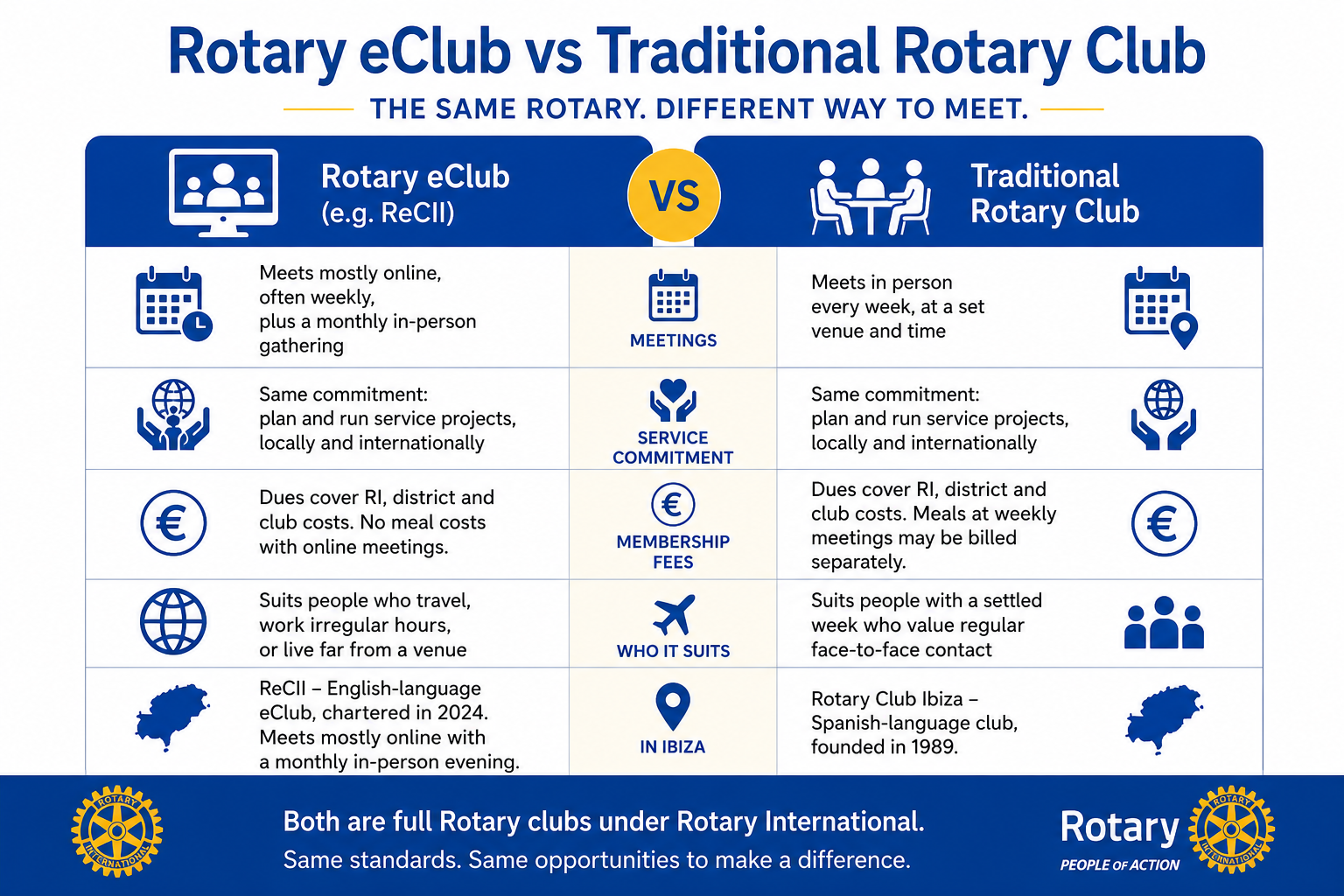
Both types meet regularly, but in different ways. A traditional Rotary club meets in person every week, usually at a set venue and time. An eClub meets mostly online, and many - including Rotary eClub Ibiza International (ReCII) - add a monthly in-person gathering.
Rotary's rules ask every club to meet at least twice a month, and allow clubs considerable freedom in how they do so. A traditional club's weekly in-person meeting offers a steady, familiar rhythm and regular face-to-face contact. An eClub's online-first pattern asks less travel of its members and lets people join from wherever they are. The choice between them is mostly a choice about how you would rather give your time.
Is the service commitment different?
No. The service commitment is the same in kind: both club types exist to carry out Rotary service, locally and internationally, and both expect members to take part in projects as well as meetings.
What an eClub changes is the logistics of taking part, not the expectation behind it. Members of either club propose and run projects, contribute to The Rotary Foundation, and are counted on to pull their weight. The scope of what a club can take on - small local projects through to international work supported by Foundation grants - is open to both equally.
What do membership fees look like?
Rotary membership involves dues in both club types, and they tend to be broadly comparable. Dues typically combine Rotary International's per-member charge, district dues, and the club's own costs.
The exact figures vary from club to club and change from year to year, so the only reliable source is the club itself. A traditional club that meets over a weekly lunch or dinner may also ask members to cover the cost of meals, which an online meeting does not involve. Beyond that, the underlying Rotary dues are similar whichever format a club uses. For our own current membership details, see how to join.
Which suits an internationally mobile person?
It depends on how settled your week is. Someone whose work keeps them in one place may value the weekly in-person rhythm of a traditional club. Someone who travels often, works irregular hours, or lives far from a meeting venue may find an eClub's online-first format easier to sustain.
In both cases the Rotary itself is unchanged - the same service, the same fellowship, the same membership of Rotary International. What differs is only what attending asks of your week.
Are there Rotary clubs of both types in Ibiza?
Yes. Ibiza / Eivissa has two Rotary clubs, and they complement rather than compete with one another. Rotary Club Ibiza, founded in 1989, is the island's long-established Spanish-language club. Rotary eClub Ibiza International (ReCII) - that is us - was chartered in 2024 as the English-language club, meeting mostly online with a monthly in-person evening.
The two clubs serve one island and a community that has grown more international over the decades, which is why a second, English-language club came to make sense alongside the first. Between them they offer a Spanish-language traditional club and an English-language eClub - two ways into Rotary for the people of Ibiza / Eivissa. To read more about our place on the island, see English-speaking Rotary in Ibiza; to confirm that an eClub carries full Rotary standing, see whether a Rotary eClub is a real Rotary club.